
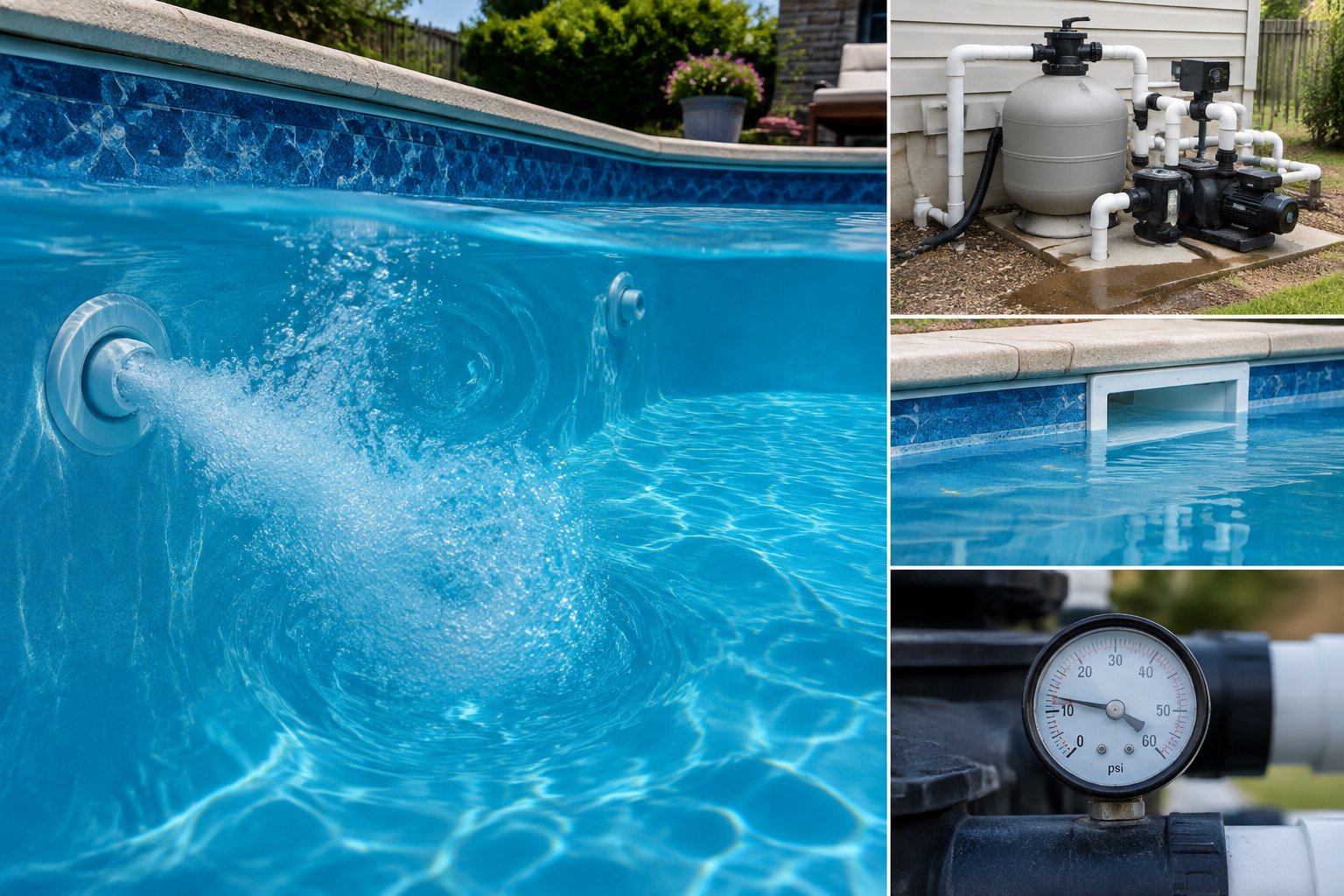
Your pool has been losing water, and the running pump seems to make it worse. That pattern points to one of the most common pool return line leak symptoms homeowners with concrete pools across the Atlanta metro run into. Return lines carry pressurized water back into the pool, so a hairline crack or loose fitting can leak steadily without ever showing up as a visible puddle.
In this guide, you will find how a pressurized leak behaves differently from other pool leaks, what visible clues to check around your deck and yard, how to tell a return line problem apart from a shell or skimmer leak, and what professional pressure testing and repair actually involve for pool owners in Marietta, Roswell, Alpharetta, and Johns Creek.
How a Pressurized Return Leak Behaves
A return line leak gets worse the moment your pump kicks on, then slows or nearly stops once the system shuts off. That single detail separates it from most other pool leaks and gives you the first real clue about where to look.
Why Water Loss Often Increases When the Pump Runs
Return lines only carry pressurized water while the circulation system is active, so any crack or loose joint pushes water out faster under that pressure. A pool that barely loses water overnight but drops noticeably during an afternoon of pump operation is showing a classic pattern tied to pressurized plumbing. This differs from suction-side leaks, which tend to pull air in rather than push water out.
The pressure isn't extreme, but it is constant during pump cycles that often run eight to twelve hours a day in the summer. Over weeks, even a pinhole-sized failure adds up to hundreds of gallons.
One pool owner on the Trouble Free Pool community forum described topping off a leaking return line weekly for years before finally isolating it. That kind of steady, unnoticed loss can gradually erode soil beneath a deck or slab if the pressure keeps pushing water into the surrounding ground.
How Individual Return Circuits and Water Features Can Change the Pattern
Most concrete pools have multiple return lines feeding different jets, and sometimes a separate line for water features like deck jets or a spa spillover. Because return lines are often distributed around the pool, isolating each one is the only reliable way to know which circuit is actually failing.
If your pool has a spa or water feature, turn that valve off for a day and watch whether the water loss changes. A shift in the loss rate narrows the search before anyone opens the ground. That kind of process of elimination is exactly what shows up next once you start walking the deck and yard for physical clues.
Visible Clues Around the Pool, Deck, and Equipment Area
The clearest sign of a return line failure is often not in the pool at all. It shows up in the yard, the deck, or the soil around your equipment pad.
Damp Soil, Wet Spots, and Higher Water Bills
A wet patch of lawn that never dries out, even during a stretch without rain, often means water is escaping underground and surfacing nearby. Buried pool lines sit in bedding material that lets water travel more easily than the surrounding clay or soil, so a leak can follow that path for several feet before it ever appears above ground.
A rising water bill with no clear explanation is another early flag. If your household usage climbs while pool refills become more frequent, that combination points toward a leak rather than normal evaporation.
Settling Pavers, Open Deck Joints, and Soil Erosion
Pavers that shift, sink, or develop new gaps between joints often mean escaping water has washed away the soil underneath. Hollow-sounding spots when you walk the deck, or coping that has started to separate from the pool shell, are physical symptoms that often show up before water level changes are even noticeable.
Expansive clay soil common across Metro Atlanta can trap water in one pocket for a while, then release it suddenly once saturation reaches a limit. That is part of why a stable-looking deck can shift quickly once a return line leak has been running for months.
Cracks, Gaps, or Dye Movement at Return Fittings
A close look at each return fitting can reveal cracks, gaps, loose screws, or stained plaster right at the jet opening. With the pump off and the water still, a small amount of pool dye released near a suspected fitting will get pulled steadily into a crack or seam if that fitting is the source.
Common signs worth checking fitting by fitting include:
- Hairline cracks radiating from the fitting collar
- Stained or discolored plaster in a ring around the jet
- A gap where the fitting no longer sits flush with the pool wall
- Dye that visibly streams toward the fitting instead of drifting past it
Confirming a leak at the fitting face is useful, but it does not tell you whether the failure is local or further down the pipe. That distinction is where the next stage of diagnosis comes in.
Is It a Return Line Problem or Another Type of Leak?
A return line leak almost always worsens with the pump running, while a shell, skimmer, or light leak tends to lose water at a similar rate whether the pump is on or off. That single comparison is the fastest way to separate a plumbing problem from a structural one.
Using a Bucket Test to Separate Evaporation From Water Loss
Place a bucket on the pool step, fill it to match the pool's water level, and mark both levels with tape. After 24 hours, compare how much the pool dropped against how much the bucket dropped from evaporation alone.
If the pool loses noticeably more than the bucket, you have a real leak rather than normal summer evaporation. The EPA's WaterSense guidance puts the threshold at more than about 2 inches of water loss per week under normal conditions, or 3 inches in hot, dry weather. Atlanta summers push evaporation higher on hot, windy days, so this test matters more here than in milder climates.
Comparing Pump-On and Pump-Off Water Loss
Run the bucket test once with the pump operating normally, then repeat it with the pump switched off for the same time period. A meaningfully higher loss during the pump-on test points to pressurized plumbing, since return lines carry pressure only while circulation is active.
This distinction matters because a shell or fitting leak tends to lose water at a similar rate whether the pump is on or off, unlike a return line leak tied specifically to system pressure. Comparing the two scenarios side by side removes most of the guesswork before calling anyone out.
When the Water Level Points to a Pool Shell, Skimmer, or Light Leak
If water loss stays steady regardless of pump status, the leak is more likely tied to the shell, a skimmer throat, or a light niche rather than the return plumbing. These leaks escape directly from the pool structure at whatever the current water level happens to be, so lowering the pool below the leak point often stops the loss entirely, a diagnostic clue worth testing before assuming a plumbing failure.
- Return line leak: worse with pump running, minimal loss with pump off
- Skimmer or light leak: steady loss regardless of pump status, often tied to a specific water height
- Shell crack: steady loss, sometimes paired with visible cracking on the pool surface
Once you know which category your leak falls into, the next step is confirming it with equipment rather than guesswork.
How Professionals Confirm and Repair the Failure
Pressure testing is the only reliable way to confirm which return line is failing and roughly where. A trained technician isolates each plumbing circuit, pressurizes it, and watches for a drop that reveals a compromised section.
Pressure Testing and Isolating Each Plumbing Circuit
Each return line is plugged at the pool end, pressurized to a set level, and monitored over several minutes. A line that holds steady pressure is ruled out, while one that loses pressure quickly confirms the leak's general location within that circuit.
This step alone during pool leak detection often narrows a whole-yard mystery down to a single pipe run. Skipping straight to excavation without this step risks opening the wrong section of concrete or soil entirely.
Locating an Underground Break Before Cutting Concrete
Once technicians confirm the source, they use listening equipment and tracer methods to pinpoint the exact break before any digging starts. This step protects your landscaping, irrigation, and hardscape from unnecessary disruption.
Getting this step right is what keeps underground pool plumbing repair limited to a small, targeted area instead of a wide trench across the yard. For homeowners in Alpharetta or Johns Creek with mature landscaping around the pool, that precision often saves thousands in replacement plantings and hardscape repair.
Repair Options and What Affects the Cost
Minor cracks near a fitting sometimes get resolved with pool crack repair or a fitting reseal, while a broken pipe section typically requires a short excavation and pipe replacement through underground pool plumbing repair. In more serious cases, where a leak has caused structural movement, pool structural repair also addresses the underlying shell damage.
Several factors influence total cost:
- Depth of the pipe and distance from the equipment pad
- Whether the break sits under decking, pavers, or open lawn
- Number of return lines needing isolation and testing
- Whether concrete pool resurfacing is needed afterward to restore the finish
- Access constraints from fencing, landscaping, or tight side yards
A straightforward fitting repair costs far less than a full excavation paired with resurfacing. Getting an accurate number starts with a proper diagnosis, not a rough guess based on symptoms alone, and calling Atlanta Leak Pros for a free estimate is the fastest way to find out exactly what your pool needs before the problem gets worse.
Act Before Escaping Water Undermines the Deck
Delaying repair on a confirmed return line leak lets escaping water keep eroding the soil that supports your deck and coping. What starts as a small crack can progress into settling pavers, hollow slabs, or separated coping within a single season of steady water loss.
Escaping water changes the support system beneath the pool deck, and warning signs include hollow sounds when walking the deck, sinking slabs, loose coping, and widening surface cracks. Left unaddressed, these symptoms tend to accelerate rather than level off, especially through Atlanta's wet spring months when soil saturation is already higher.
The cost difference between early action and delayed repair is significant. A targeted underground pool plumbing repair addressing a single break is far less invasive than a pool structural repair needed after months of soil erosion has compromised the shell or deck foundation.
Homeowners in Marietta and Roswell with older concrete pools should treat any confirmed return line symptom as a scheduling priority, not a wait-and-see item. The next reasonable step is getting a professional set of eyes on the specific behavior you have already documented.
Frequently Asked Questions
Why does my pool lose more water when the pump is running?
Return lines only carry pressurized water while the pump is active, so any crack or loose fitting pushes out more water under that pressure. Once the pump shuts off, pressure drops and water loss slows or nearly stops, which strongly suggests a return line issue.
How do I know if my pool pipe is leaking underground?
Watch for damp soil, sunken spots near the deck, or a water bill that keeps climbing for no obvious reason. A bucket test comparing pump-on and pump-off water loss, followed by professional pressure testing, confirms whether an underground pipe is the source.
Can a pool return line leak be repaired without draining the pool?
Many return line repairs are done with the pool only partially drained, since the pipe runs below the waterline but outside the shell itself. The exact approach depends on where the leak is and whether you need to excavate near the equipment pad or under the deck.
Where do in-ground pool return lines usually leak?
Most failures happen at the fitting where the pipe connects to the pool wall, since that joint experiences the most stress from ground movement and pressure cycles. Underground breaks further down the pipe run also happen, especially in areas with soil movement or aging PVC.
How much does pool return line leak repair cost?
Cost depends on the pipe depth, how far the break is from the equipment pad, and whether decking or pavers need to be removed for access. A simple fitting reseal costs far less than a full excavation and pipe replacement, so an accurate number requires a proper pressure test and diagnosis first.
Wrapping Up What Your Pool Is Telling You
A pool that loses more water with the pump running, paired with damp soil, settling pavers, or visible cracks near a return fitting, shows a pattern worth taking seriously. These pool return line leak symptoms rarely resolve on their own, and the longer pressurized water escapes underground, the more it threatens the soil supporting your deck and shell.
Bucket tests and pump-on versus pump-off comparisons give you a solid first read on what type of leak you are dealing with. From there, professional pressure testing turns that suspicion into a confirmed diagnosis, and targeted repair work, whether that is a simple fitting reseal or a full underground plumbing repair, keeps the fix proportional to the actual problem.
Ready to stop guessing and start fixing? Atlanta Leak Pros will inspect your pool and give you a clear, honest estimate at no cost.
Free estimates on leak detection and repair across metro Atlanta. Mention the promotion for $25 off leak repairs.